
SpaceX Euphoria and Investor Perspective
We don’t often field inquiries about Initial Public Offerings (IPOs) but it is hard to ignore the current hype of the upcoming SpaceX IPO. Why the euphoria?
For one, SpaceX anticipates raising a record-breaking $75 billion at a valuation of $1.75 Trillion. The largest IPO in history occurred in 2019, when state-owned Saudi Aramco raised $29.4 billion. Assuming an IPO share price of $135 for SpaceX, their IPO will be 2.5 times bigger than Saudi Aramco’s.
Secondly, the offering could lead to Elon Musk becoming the world’s first trillionaire. That’s not a typo, trillionaire with a “T”. As the world's most ambitious tech entrepreneur, he’s either started or been significantly involved in the following businesses: Tesla, PayPal, Twitter now “X”, Open AI -ChatGPT- and SpaceX. He’s changed the world in many ways and investors fear missing out on the next big thing.
SpaceX’s IPO is just the beginning as both Open AI and Anthropic (Claude) are expected to launch their own initial public offerings, eyeing valuations close to a trillion, respectively. Each company anticipates raising significantly more than Saudi Aramco back in 2019. It is very likely we will be witnessing the three largest IPOs in history over the next 12-18 months.
While SpaceX news is generating the latest headlines, numerous semiconductor and hardware stocks have “lifted off” as well. The Philadelphia Semiconductor Index (SOX) has soared nearly 80% so far this year, marking its best start to a year since its inception in 1993. In April, the index logged a 17-day consecutive winning streak, the longest in 32 years. When Nvidia’s CEO, Jensen Huang declared Marvell Technology would be “the next trillion-dollar company”, the market responded by sending the stock up 32% in a single day. Old-school hardware stock names, Dell and Hewlett Packard, are up 230%+ and 125%+ year-to-date. These impressive and “not typical” returns can easily allow you to bring down your guard as an investor but at times like this, you must also be prepared for the downside risks.
A few facts to consider:
- At $1.77 trillion, SpaceX is being priced at roughly 92 times its annual revenue…..not earnings.
- 9,365%. That’s how much larger SpaceX’s projected valuation of $1.77 trillion is than its 2025 revenue. In comparison, Lineage, the largest IPO by market valuation in 2024 ($18 billion), had a valuation roughly 240% larger than its revenue. Medline, the largest IPO by market valuation in 2025 ($55 billion), completed its debut with a market value about 116% larger than its revenue.
- While Starlink is profitable, SpaceX as a whole is unprofitable. SpaceX posted an overall net loss of $4.9 billion for 2025, driven by the immense capital expenditures (CapEx) required for Starship and speculative orbital data centers.
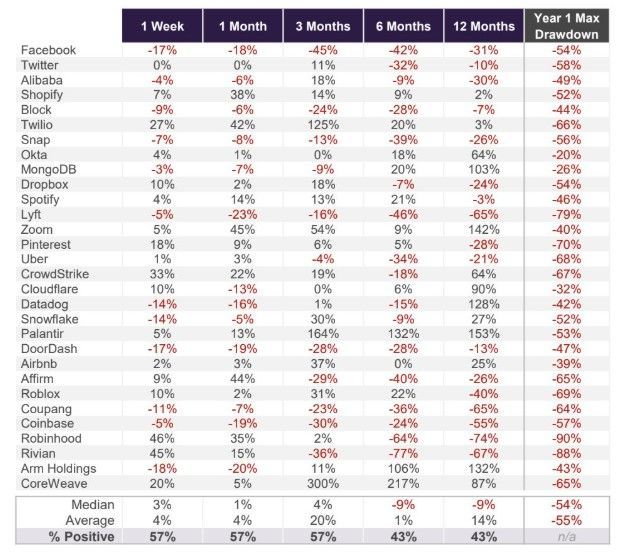
- A historical study by Truist (see below) examined 30 of the most celebrated mega-IPOs in recent memory.. The standout figure? The average maximum first-year drawdown was -55%, while the median first-year return was -9%. (source: Truist Bank - Keith Lerner)
Historically, many tech companies operated with extraordinary profit margins as asset-light models but the rise of artificial intelligence and cloud computing is pushing many of these companies into capital intensive, asset-heavy operations. Often, they self-funded their operations but now they are seeking financing by issuing debt. In 2025, five companies (Amazon, Alphabet, Meta, Microsoft and Oracle) alone issued over $120 billion in corporate bonds. This represented a 500% increase from 2024. The implications of this changing landscape are yet to be known. Will the profits follow the massive spending?
Another question that arises is where do the funds to participate in the IPO come from? At the individual retail investor level, it may come from cash. At the institutional level, it likely comes from the sale of other equities or various asset classes, such as Bitcoin. A darling a few years back, Bitcoin is down over 25% YTD and almost 40% lower than it was a year ago. Rebalancing funds from other equities into these IPOs could cause downward pressure on broad market index funds.
SpaceX, Anthropic, and OpenAI are undeniably reshaping the future of human technology. But a revolutionary company is not automatically a sound investment at any price tag. This is not to say these companies can’t or won’t be good investments in the long-term, just that the fundamentals will eventually need to match the hype. We are not taking a stance on the worthiness of the underlying investment but you should be prepared for the expected volatility that often follows an IPO.
We consistently advise investors to maintain a long-term perspective and equally important, be mindful of risk. This advice applies not only during market turbulence but also when the market’s been on a significant upswing for the last several years. Ongoing risks include high inflation and corresponding elevated interest rates, the Iran War, mid-term elections, stretched equity valuations and CapEx spending. The current risk-reward proposition suggests maintaining a diversified portfolio that fits your actual risk tolerance. The surging market and hype surrounding AI can create illusory shifts in risk tolerance, where you feel your risk tolerance is more than what it truly is. Ultimately, staying grounded in your true risk profile is the best way to capitalize on market growth without compromising your long-term financial security.
As always, if you have questions or concerns about your individual situation, please don’t hesitate to contact us.